Your official source for Apex Strategy company news, strategic announcements, service updates, and major milestones.
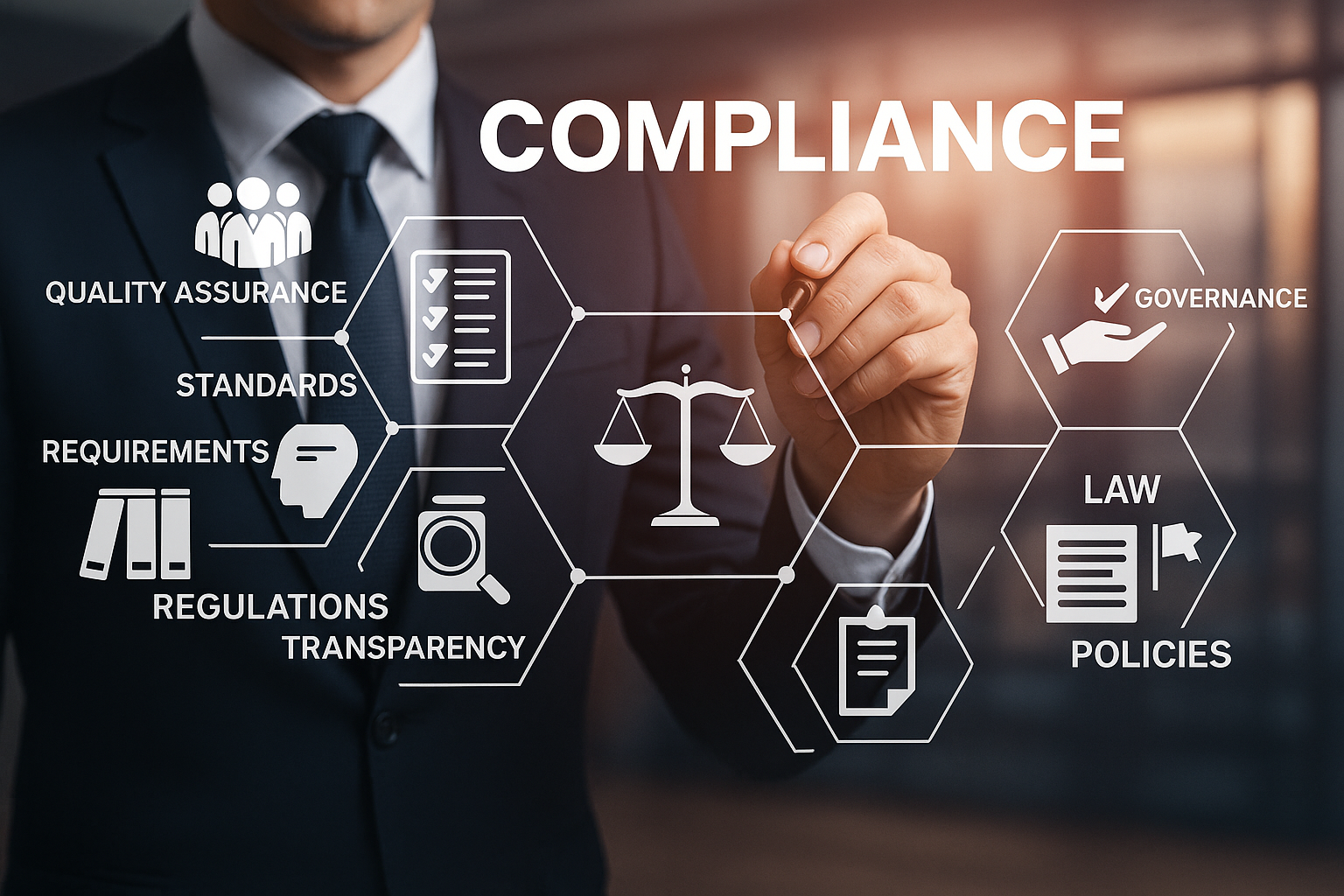
Understanding Modern Compliance Frameworks: What Businesses Need to Know in 2025
Understanding Modern Compliance Frameworks: What Businesses Need to Know in 2025
In today’s digital-first economy, trust has become currency. Whether you're running a SaaS platform, collecting payment information, storing personal data, or operating in a highly regulated sector, your ability to protect sensitive information is no longer optional — it’s a competitive differentiator. Compliance frameworks help organizations standardize their approach to data protection, cybersecurity, privacy, and operational maturity, ensuring that systems and processes are not only secure, but provably so.
This article explores six of the most influential compliance frameworks shaping modern business today:
-
SOC 2
-
ISO 27001
-
HIPAA
-
NIST Cybersecurity Framework
-
PCI DSS
-
GDPR
Each addresses a different piece of the cybersecurity and privacy landscape. Understanding how they work — and how they overlap — is essential to building a modern, compliant, and trustworthy organization.
SOC 2: The Trust Standard for Service Providers
SOC 2 (Service Organization Control 2) has emerged as a cornerstone of security assurance in the SaaS and cloud services space. Developed by the AICPA, SOC 2 evaluates how effectively a service organization safeguards customer data across five Trust Services Criteria: Security, Availability, Processing Integrity, Confidentiality, and Privacy.
SOC 2 doesn’t certify a product — it attests to the maturity of an organization’s internal controls. A Type I report examines the design of these controls, while a Type II verifies how well they operate over time. For many B2B companies, a SOC 2 report is no longer a nice-to-have; enterprise buyers often require it before signing a contract.
Industry Use Cases
-
SaaS providers hosting customer data
-
Managed cybersecurity or IT service firms
-
Cloud storage or backup platforms
-
Workforce and payroll platforms
-
Healthcare-adjacent apps handling sensitive (but not legally protected) data
Best Practices
-
Implement a formal data classification system
-
Maintain auditable, documented processes for security and operations
-
Monitor controls continuously — not only pre-audit
-
Train staff on privacy and access responsibilities
-
Use your SOC 2 attestation as a sales enablement tool
In short, SOC 2 builds confidence that your business protects data in practice, not just on paper.
ISO/IEC 27001: The Global Benchmark for Information Security
ISO 27001 is the world’s leading security management certification standard. Unlike SOC 2, which generates an attestation, ISO 27001 certifies that an organization has implemented an Information Security Management System (ISMS) — a continuous lifecycle of security governance, risk management, and improvement.
ISO 27001’s strength lies in its global recognition. For organizations operating internationally or handling cross-border data, it signals cybersecurity maturity at a globally accepted level.
Industry Use Cases
-
Multinational software vendors
-
Fintech organizations handling highly sensitive transactions
-
Cloud infrastructure providers
-
Enterprises with complex supply chains and vendor relationships
-
Healthtech firms seeking international growth
Best Practices
-
Establish a formal ISMS aligned with leadership accountability
-
Map shared controls across frameworks (SOC 2, GDPR, PCI DSS, etc.)
-
Conduct internal audits and management reviews regularly
-
Train employees continuously, not only at onboarding
-
Use ISO 27001 as a foundation to layer additional regulatory compliance
ISO 27001 isn’t just about preventing breaches — it proves your organization has structured, repeatable, and continually improving security practices.
HIPAA: Protecting Healthcare Information in the United States
HIPAA (Health Insurance Portability and Accountability Act) is a U.S. federal mandate controlling the privacy and security of protected health information (PHI). If you are a healthcare provider, insurer, clearinghouse, or business associate handling PHI, HIPAA is not optional — it’s law.
HIPAA regulations are split into several rules, but the Security Rule is the most relevant for cybersecurity. It requires organizations to implement safeguards that protect PHI’s confidentiality, availability, and integrity.
Industry Use Cases
-
Hospitals, clinics, dental practices, and telehealth services
-
Electronic Health Record (EHR) providers
-
Insurance companies and medical billing firms
-
Medical device manufacturers with digital data flows
-
Healthcare AI or analytics platforms processing outcomes or diagnostics
Best Practices
-
Encrypt PHI both at rest and in transit
-
Implement role-based access with least-privilege controls
-
Maintain comprehensive audit logs of PHI access
-
Train employees continuously on PHI handling obligations
-
Develop and test breach notification and incident response processes
HIPAA teaches a crucial lesson: cybersecurity isn’t merely internal policy — it’s patient trust.
NIST Cybersecurity Framework: A Roadmap for Resilient Security
The NIST Cybersecurity Framework (NIST CSF) is one of the most adaptable and widely used frameworks in the United States. Originally designed for critical infrastructure, it has since become a go-to model for organizations of all sizes.
NIST is not a certification program — it’s a practical playbook consisting of six core functions: Govern, Identify, Protect, Detect, Respond, and Recover. Unlike rigid standards, NIST allows organizations to tailor controls to their risk tolerance, industry, and resources.
Industry Use Cases
-
Small-to-medium enterprises maturing cybersecurity programs
-
Utilities, transportation, and public infrastructure
-
Government contractors subject to federal requirements
-
Enterprises migrating workloads to cloud environments
-
Organizations requiring cohesive risk management practices
Best Practices
-
Begin with a risk-based assessment of current capabilities
-
Build a target security profile aligned with business needs
-
Integrate monitoring, detection, and incident response
-
Use NIST as a bridge to other frameworks (ISO 27001, SOC 2, etc.)
-
Continuously test, measure, and refine security controls
NIST is particularly valuable because it meets companies where they are — and guides them into where they need to be.
PCI DSS: Securing Payment Card Data Everywhere It Lives
If your organization stores, processes, or transmits credit or debit card data, the Payment Card Industry Data Security Standard (PCI DSS) applies to you. Unlike other frameworks, PCI DSS requirements are enforced by payment brands and financial institutions — failure to comply can result in fines or revoked processing privileges.
PCI DSS mandates strict controls around the protection of cardholder data, authentication, encryption, and network segmentation.
Industry Use Cases
-
E-commerce retailers
-
Payment gateways and processors
-
Hospitality and point-of-sale systems
-
Subscription platforms storing card information
-
Mobile apps handling card-not-present transactions
Best Practices
-
Encrypt cardholder data at every stage
-
Segment networks that process payment information
-
Enforce multi-factor authentication and privilege management
-
Test systems continuously through scans and penetration testing
-
Maintain audit logs for transactions and administrative access
PCI DSS is one of the most technically specific frameworks — and one of the most unforgiving for organizations who treat it lightly.
GDPR: The Global Standard for Data Privacy
The General Data Protection Regulation (GDPR) has reshaped data privacy laws worldwide. What sets GDPR apart is its reach: if you process the data of EU citizens, you must comply — no matter where your company is located.
GDPR grants individuals powerful rights over their data (including access, erasure, portability, and consent), and imposes steep penalties for violations, making it a foundational privacy requirement for any organization with international users.
Industry Use Cases
-
SaaS and cloud platforms collecting personal data
-
E-commerce businesses shipping internationally
-
Marketing and analytics firms handling behavioral insights
-
Healthcare and financial applications
-
Any business hosting EU customer accounts
Best Practices
-
Implement privacy-by-design into systems and workflows
-
Minimize data collection and retention wherever possible
-
Be transparent about processing, purpose, and retention policies
-
Support user rights requests efficiently and traceably
-
Maintain breach notification and oversight mechanisms
GDPR is the reminder that data doesn’t belong to organizations — it belongs to people.
Choosing the Right Framework: Layered Compliance Wins
Few organizations operate under a single compliance regime. In reality, frameworks overlap:
-
A SaaS company may need SOC 2 for U.S. customers, ISO 27001 for European clients, PCI DSS for billing, and GDPR for privacy.
-
A health-tech vendor must satisfy HIPAA while leveraging ISO 27001 or NIST to mature its cybersecurity posture.
The smartest security programs build one cohesive foundation — then layer on required frameworks based on industry, geography, and data sensitivity.
 Final Thoughts
Compliance is no longer a checkbox. It’s a signal of organizational maturity, a competitive advantage, and a foundational requirement for operating in a data-driven world. Whether you're a startup preparing for enterprise procurement, a healthcare company handling PHI, or a global retailer processing payments across continents, these frameworks guide the technologies, processes, and behaviors that protect your business — and the people who trust it.
Security isn’t a destination. It’s an ongoing practice.
- Hits: 154