Your official source for Apex Strategy company news, strategic announcements, service updates, and major milestones.

The Genesis Mission: What Trump’s Executive Order Means for AI, American Industry, and the Future of the U.S. Economy
The Genesis Mission: What Trump’s Executive Order Means for AI, American Industry, and the Future of the U.S. Economy
On November 24, 2025, President Donald J. Trump signed a sweeping Executive Order establishing The Genesis Mission, a national initiative designed to place the United States decisively at the forefront of artificial intelligence, scientific discovery, and economic competitiveness. While the order is framed as a scientific acceleration program, its implications extend far beyond the research community. It signals a structural shift in how the Federal Government intends to harness AI, reorganize its technological capabilities, and re-position the nation for strategic dominance in the global innovation race.
For anyone working in AI, high-tech manufacturing, energy, national security, or enterprise-level data and analytics, the Genesis Mission represents one of the most consequential federal moves in decades. It is part industrial strategy, part economic stimulus, part security policy, and part long-term national infrastructure investment. And in many ways, it might become the most significant U.S. science initiative since the Manhattan Project — a comparison the order itself makes plainly.
To understand its full impact, it’s important to break down the mission’s intent, its structure, and what it practically means for American industry.
A National Technological Mobilization
The Genesis Mission is framed as a response to a simple reality: AI is becoming the foundational technology of the global economy, and the countries that master AI-enabled scientific discovery will shape the next century. The United States already leads in commercial AI innovation, but global competition — especially from China — has intensified. The Executive Order positions AI not as an optional advantage but as a strategic necessity.
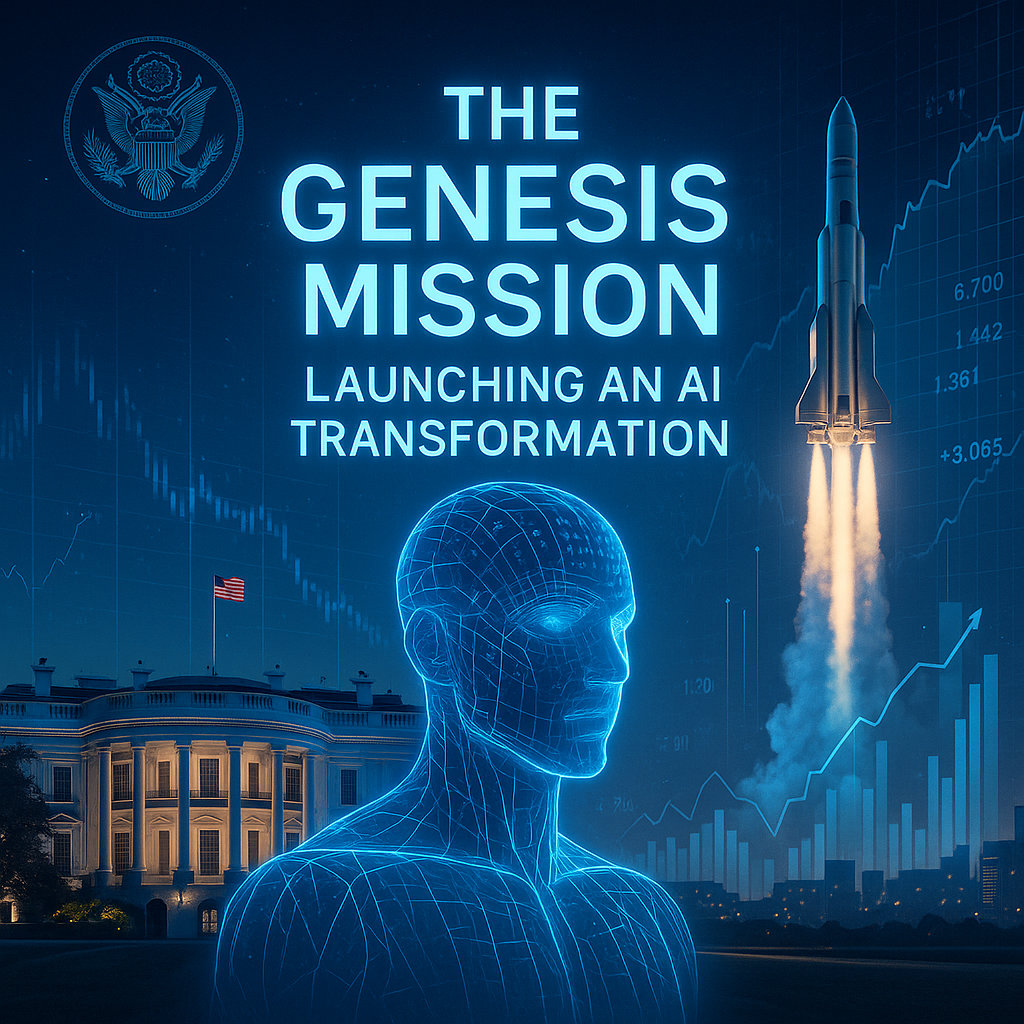 The core purpose is to create an integrated AI super-infrastructure, capable of:
-
Training scientific-grade foundation models
-
Automating research workflows
-
Running national-scale simulations
-
Accelerating high-risk/high-reward scientific breakthroughs
-
Standardizing data flows across agencies and sectors
But beyond the technical goals, the order carries a deeper economic message: innovation is no longer an isolated sector; it is an ecosystem. Federal datasets, national laboratories, commercial partners, universities, and defense assets are all being aligned into a single AI-powered engine.
This is not merely “government investing in AI.” It is the government reorganizing itself around AI.
The American Science and Security Platform: A New AI Research Backbone
At the heart of the mission is a new national infrastructure called the American Science and Security Platform. This platform will unify supercomputers, high-performance cloud resources, AI agent frameworks, scientific models, and massive federal datasets into a single operational environment.
Economically and technologically, this represents three major shifts:
The Federal Government Is Becoming a Central AI Compute Provider
One of the most transformative aspects of the Genesis Mission is the consolidation of federal AI computing power. By integrating national laboratory supercomputers with secure, cloud-based AI environments, the United States is effectively eliminating decades of fragmented, agency-by-agency infrastructure. Instead of each department managing its own closed systems, the Department of Energy will operate as the unified computational backbone for the entire Federal Government.
This shift immediately changes the economic landscape. It creates a long-term demand pipeline for private AI developers, specialized hardware companies, semiconductor manufacturers, cloud service platforms, and cybersecurity firms. The order makes it clear that industry participation is not only welcome but essential. Businesses capable of building tools, models, and AI-driven research frameworks that match federal scientific priorities will be positioned to form durable partnerships with the government. In effect, the DOE’s new role as the nation’s compute hub becomes a catalyst for commercial innovation, opening the door to one of the most significant public-private technology ecosystems in modern American history.
AI Agents Will Become Standard Tools for Federal Science
Another defining aspect of the Genesis Mission is its explicit embrace of autonomous AI agents as core instruments of federal research. Only a year ago, the idea of AI routinely “exploring design spaces,” “automating workflows,” or “evaluating experimental outcomes” would have been considered aspirational. The Executive Order, however, treats these capabilities as essential and immediate. It signals a shift from traditional, human-paced scientific cycles to a model of continuous, AI-driven discovery.
This shift carries enormous consequences for industries built on complex research pipelines. Fields such as pharmaceutical development, materials engineering, next-generation batteries, clean energy systems, advanced manufacturing, and quantum science will no longer be limited by the slow, sequential trial-and-error methods that have defined them for decades. By integrating AI agents capable of running simulations, analyzing variables, and iterating experiments at machine speed, the federal ecosystem is laying the groundwork for scientific acceleration on a scale not seen before. Breakthroughs that once required decades of incremental refinement may now emerge in a fraction of the time, reshaping competitive dynamics and redefining what is technologically achievable across the American economy.
Secure Data + National AI = A New Industry Frontier
Perhaps one of the most economically significant elements of the Genesis Mission is its treatment of federal datasets as strategic assets. The United States possesses some of the largest and most valuable scientific data repositories in the world — climate records, environmental sensor networks, nuclear research archives, energy system data, and expansive health and biomedical datasets, all built over decades of federal investment. Until now, these datasets have largely lived in isolated silos, accessible only through narrow channels and fragmented research programs.
The Genesis Mission changes that landscape entirely. By enabling secure, governed, and AI-ready access to these resources, the government is creating a new foundation for innovation across the private sector. Entire industries stand to benefit. Climate technology companies can model environmental shifts with unprecedented precision. Biotech firms gain access to scientific baselines that can accelerate drug discovery and genomic research. Clean-energy innovators can simulate next-generation power systems with far more accuracy. Agriculture technology, defense analytics, autonomous manufacturing, and countless other sectors will be able to build products, services, and breakthroughs on top of data that previously could not be leveraged at scale.
The economic value locked inside these datasets is immense. Once unified through AI-driven infrastructure, the ripple effects will extend across the entire U.S. innovation economy. For businesses prepared to operate at the intersection of secure data and advanced AI, the opportunity is nothing short of transformational.
A Manhattan-Project-Scale Approach to Innovation
By invoking the Manhattan Project, the Executive Order sets expectations: this is intended to be a transformational, not incremental, mobilization of national resources.
A few critical parallels stand out:
Centralized Leadership
Where the Manhattan Project had the War Department and Los Alamos, the Genesis Mission has the DOE and the Assistant to the President for Science and Technology. Centralized leadership is unusual for modern federal scientific work, and it signals seriousness.
Integrated Public-Private Ecosystem
A defining feature of the Genesis Mission is its emphasis on building a deeply integrated ecosystem that brings together every corner of America’s scientific and industrial landscape. The Executive Order highlights the essential collaboration between national laboratories, private-sector technology companies, universities, cloud infrastructure providers, semiconductor manufacturers, and major research facilities. Rather than operating as isolated contributors, these entities are being aligned into a coordinated, purpose-driven network.
This approach mirrors the multi-sector mobilization that powered the Manhattan Project, but with an important difference: today’s breakthroughs emerge at digital speed. AI allows research, simulation, and experimentation to run continuously and autonomously, meaning collaborative innovation can advance far faster than traditional models ever allowed. The Genesis Mission leverages this reality, creating a modern public-private alliance designed not just to keep pace with global competitors, but to outpace them through the combined force of America’s scientific and industrial capabilities.
Security Is a Structural Priority
The term “security” appears throughout the document. The mission is not only scientific — it is a cornerstone of national defense in an era where cyber, AI, and computational power shape global strategy.
For companies working in protected sectors, compliance with national security standards will be a prerequisite for partnership.
The Economic Impact: Catalyzing a New Innovation Boom
From an industry perspective, the Genesis Mission is not just science policy — it is economic policy. The Executive Order outlines an innovation strategy that will reshape how capital flows into U.S. technology for years to come.
Here are the major economic effects:
Accelerated Commercialization Cycles
One of the most immediate economic impacts of the Genesis Mission is the speed at which new technologies will reach the marketplace. By shifting much of the research, simulation, and experimental workload to AI systems, early-stage innovations can progress through development phases far more rapidly than before. This acceleration reshapes the competitive landscape for startups striving to challenge global leaders, for industries built around lengthy R&D cycles, and for domestic manufacturers looking to sharpen their edge. It also creates a more dynamic environment for investors, who gain access to high-leverage opportunities with shorter timelines and clearer paths to commercialization. With AI compressing research horizons, the nation can expect faster patent production, quicker product iterations, and dramatically reduced time-to-market across numerous sectors.
Strengthening Domestic Manufacturing and Supply Chains
The Order’s focus on advanced manufacturing, critical materials, and semiconductor development reflects a strategic effort to rebuild the backbone of American industry. Instead of relying on fragile or geopolitically vulnerable supply chains, the United States is positioning itself to reclaim manufacturing capabilities that were previously offshored. The Genesis Mission supports a broader national plan to increase domestic semiconductor production, expand U.S. fabrication capacity, and restore autonomy in technological areas that underpin everything from consumer electronics to military systems. If fully executed, this initiative could serve as the intellectual and technological foundation for a new generation of industrial policy—one that prioritizes resilience, innovation, and long-term economic sovereignty.
Boosting Workforce Productivity and Talent Pipelines
Another transformative element of the Genesis Mission lies in its deliberate cultivation of future talent. The Order establishes a suite of training pathways—fellowships, apprenticeships, internships, and specialized AI-driven scientific programs—that place students and emerging researchers directly inside DOE-run AI environments. This approach tackles one of the most persistent challenges in the technology sector: a shortage of highly skilled workers capable of steering sophisticated research efforts. By connecting talent development to national laboratories, advanced compute systems, and cutting-edge research environments, the Mission helps build a workforce ready to operate at the frontier of AI-enabled discovery. Over time, this will not only increase national productivity but also ensure that America has the human capital required to sustain leadership in a rapidly evolving global technology landscape.
Unlocking New Markets Through Public-Private Partnerships
The order instructs agencies to incentivize private-sector participation, including funding opportunities and competitive projects. This ensures that innovation flows both ways:
Federal research supports industry, and industry innovation enhances federal capability.
Strategic Implications: American Leadership in a Multipolar AI World
Beneath its scientific language, the Executive Order reads unmistakably as a geopolitical statement. Artificial intelligence has become inseparable from national defense, economic security, supply chain stability, diplomacy, energy independence, and cyber readiness. The decision to consolidate federal AI capability under the Department of Energy reflects this reality. The DOE is home to the nation’s most advanced supercomputers, and in a world where computational power increasingly determines global influence, placing the mission under DOE control aligns technological capability with strategic necessity.
From a broader strategic perspective, the Genesis Mission is designed to ensure that the United States maintains sovereign control over critical AI models rather than relying on foreign technologies or overseas infrastructure. It accelerates domestic innovation, strengthens American deterrence by expanding technological superiority, and builds a unified scientific ecosystem that can compete directly with highly centralized research structures in countries like China. Although the order leaves room for international collaboration, it does so with explicit security safeguards, signaling that partnerships will be chosen carefully and governed by national interest.
The Bigger Picture: A New Era of AI-Driven Governance
The Executive Order represents more than a research initiative—it signals a fundamental reorganization of how the federal government approaches scientific discovery and national strategy. Rather than using AI as a supplementary tool for administrative tasks, the Genesis Mission embeds AI into the core operational structure of federal science, security planning, and industrial development. In many ways, it seeks to accomplish for artificial intelligence what the Manhattan Project accomplished for nuclear science: establishing a technological foundation capable of reshaping global power dynamics and domestic industry for decades.
If the mission succeeds, it could transform the entire federal innovation pipeline, reorganizing how agencies conduct research, allocate resources, and collaborate with industry. It may redefine America’s energy systems, defense frameworks, semiconductor and manufacturing capacities, workforce development programs, and commercial adoption of AI technologies. Ultimately, the Genesis Mission marks the beginning of a structural transition in which AI no longer functions as a single industry but instead becomes the underlying operating system for American innovation, governance, and economic leadership.
Conclusion: A Turning Point for U.S. Technological Leadership
The Genesis Mission is a declaration that the United States intends not only to compete in the global AI race but to dominate it. By integrating federal supercomputers, securing critical datasets, mobilizing national laboratories, and partnering with private industry, the initiative lays the groundwork for a new era of scientific acceleration.
For the U.S. economy, the impacts will be profound. Entire markets will emerge around AI-powered discovery. Talent pipelines will expand. Manufacturing, energy, and biotech will undergo AI-driven reinvention. And America’s strategic position in the world will be strengthened by technological leadership rather than erosion.
While much depends on execution, funding, and interagency cooperation, the intent is clear:
AI is now a core pillar of national power, and the United States is reorganizing itself accordingly.
For business leaders, innovators, technologists, and policymakers, the message is unmistakable — the next wave of American growth will be driven not just by AI as a tool, but by AI as a national infrastructure.
Genesis Mission, Artificial Intelligence, AI Policy, Executive Orders, National Security, U.S. Economy, Technology Innovation, High-Performance Computing, Department of Energy, Scientific Research, Federal Technology Strategy, AI Infrastructure, Economic Development, Innovation Ecosystem, Government Technology
- Hits: 145